
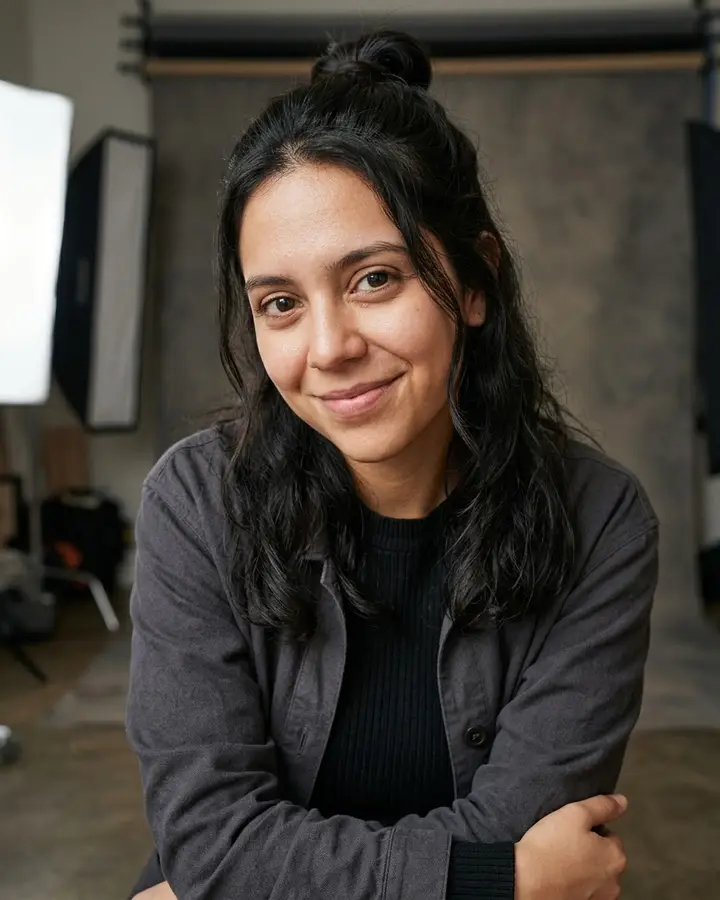
Why a studio portrait works
Your first photo needs a clear face, and nothing is clearer than a portrait with soft light and a plain background. People see your eyes, your smile, your real features.
It also covers you if your other photos are casual, a bit far away, or taken in mixed light. One sharp face shot makes the rest easier to read.
How to shoot it yourself
- You don't need a studio. A plain wall and a big window will do. Stand about an arm's length from the wall so your shadow doesn't land on it.
- Use window light from the side or slightly in front, on a cloudy day or out of direct sun. Soft light is the whole point.
- Background: warm gray, off-white, or a muted color. Pure white can make skin look flat.
- Men: a crew-neck knit, a plain tee, or a casual shirt with the top button open. No tie, no suit jacket, unless you want it to look like a work photo.
- Women: a solid-color top with a neckline you like, no busy patterns, hair the way it looks on a normal good day.
- Pose: shoulders turned a little away from the camera, face back toward it, chin slightly forward and down. Think of something funny right before the shot.
- Who shoots: a friend with a phone a few steps away, at your eye level, zoomed in a little. Not a selfie, because a lens that close distorts your face.
Studio portrait mistakes to avoid
- Using more than one. Two studio shots and the profile starts to feel like an ad.
- Corporate smile, crossed arms, blazer. That's a promotion photo.
- Heavy retouching. Smoothed skin and brightened eyes look fake, and the difference shows in person.
- A dark, moody, black-background look. Dramatic, but it rarely comes across as approachable.
- No follow-up. A studio portrait has to be followed by photos of you somewhere real, doing something.
If it's AI-generated, resist perfect
Keep it simple: soft background, natural skin texture, normal light. The more flawless it looks, the more it looks generated.
Check your face carefully. It should look like you on a good day, not like your sibling who models. Pores, a bit of asymmetry, and your real hairline all help. Match the clothes to your actual style. And put it next to real-life scenes, so the profile reads like a person and not a photoshoot.